
TCADP’s Statement on the Execution of Edward Busby, the 600th Person Put to Death by Texas Since 1982
May 14, 2026
You have a critical role to play in stopping executions in Texas. On this page, you will find information about scheduled executions, the clemency process and current clemency campaigns, and how to contact the Governor of Texas and the Texas Board of Pardons and Paroles.
Learn about other active cases, including the ongoing quest for justice for Robert Roberson and Charles Flores.
Read about select clemency campaigns that have taken place in recent years.
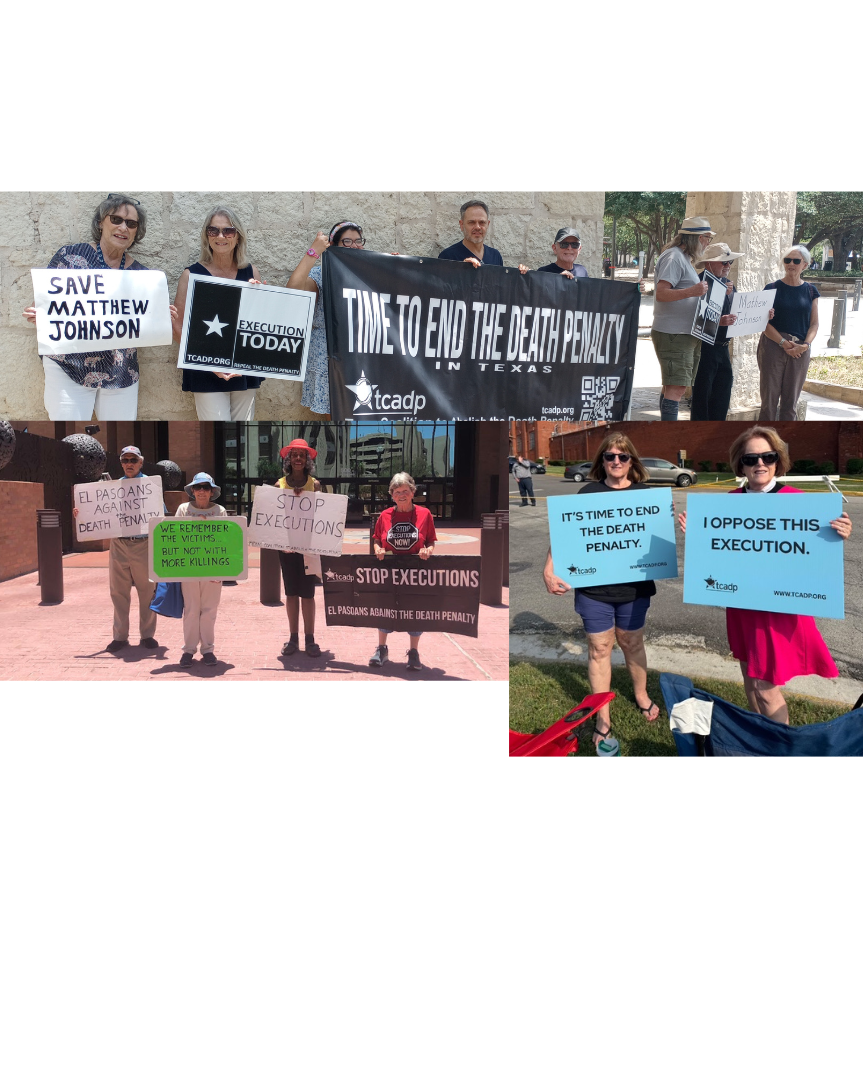
On the days of scheduled executions, we encourage you to take part in vigils in your area. Follow TCADP on social media for case updates (@TCADPdotORG on X/Twitter and @tcadp on Instagram and Facebook).
Texas Executions in 2026
Executions (5)
On January 28, 2026, Texas carried out the nation’s first execution of the year, putting Charles Thompson to death for killing Dennise Hayslip, his on-and-off girlfriend, and her friend Darren Cain in 1998 in Tomball (a Houston suburb). Thompson, who was 55, spent nearly 27 years on death row.
Thompson used his final moments to apologize to the families of Hayslip and Cain and ask for their forgiveness. “There is no winners in this situation, it creates more victims and traumatizes more people 28 years later,” Thompson said.
***
On March 11, 2026, the State of Texas executed Cedric Ricks. Ricks was sentenced to death for killing his girlfriend, Roxann Sanchez, and her eight-year-old son, Anthony Figueroa, in Tarrant County in 2013. In his last words, he expressed his remorse and apologized to Sanchez’s surviving son.
Ricks’s cert petition and application for a stay of execution were denied by the Supreme Court of the United States earlier in the day. His attorneys had asked the Justices to intervene, arguing prosecutors violated Ricks’ constitutional rights by eliminating potential jurors on the basis of race.
***
James Broadnax was executed by the State of Texas on April 30, 2026. He was sentenced to death at age 20 by a nearly all-white jury in Dallas in 2009. His case raised serious concerns, including the use of his rap lyrics as evidence of his “future dangerousness,” the exclusion of Black jurors, and a recent confession by his co-defendant, Demarius Cummings, that he was responsible for killing Stephen Swan and Matthew Butler during the robbery, not James.
Despite these unaddressed issues, and despite evidence of James’s personal growth, rehabilitation, and commitment to mentoring others during his nearly two decades on death row, the courts and Governor declined to intervene, and clemency was denied.
In a statement provided after the execution, his attorneys and wife shared that “James was a caring, thoughtful, spiritual and deeply intelligent person who positively impacted all who came to know him. He will be missed by all of us and by his family and many friends. James spoke often of his feelings for the families of Mr. Swan and Mr. Butler, and about his remorse for his role in these crimes, and our thoughts at this time are with their families as well, as James’ were.”
***
On May 14, 2026, the State of Texas executed Edward Busby after the Supreme Court of the United States vacated a stay that had been granted by the Fifth Circuit Court of Appeals. Experts agreed that he had intellectual disability and should have been exempt from the death penalty. Read TCADP’s statement.
***
On September 16, 2026, Texas executed LeJames Norman for his role in the murders of Sam Roberts, Tiffani Peacock, and Celso Lopez during a botched robbery in 2005 in Edna, Texas (Jackson County).
Norman had asked the Supreme Court of the United States to stay the execution and consider his petition that his death sentence was obtained through false evidence and arguments presented by prosecutors. The Court denied both requests about three hours before the scheduled execution.
***
Ker’Sean Ramey was executed by the State of Texas on September 23, 2026, after the Supreme Court of the United States and Texas Governor Greg Abbott refused to intervene.
After deliberating for only 14 minutes, a jury sentenced Ramey to death for his role in the murders of Sam Roberts, Tiffani Peacock, and Celso Lopez during a botched robbery in 2005 in Edna, Texas. He was 20 years old at the time and spent nearly half his life on death row. LeJames Norman was put to death one week ago for the same crime.
Ramey’s trial was marred by serious constitutional violations, including the systematic exclusion of all potential Black jurors, the State’s presentation of false testimony, and, above all, the abysmal performance of his trial attorney—a full-time dentist and part-time lawyer—who failed to conduct his own investigation or provide witnesses to rebut the State’s case.
Ramey was the fifth consecutive Black man to be put to death by the State of Texas.
Scheduled Executions (3)
Jamaal Howard: October 7, 2026 (Hardin County)
Urge clemency for Mr. Howard.
John Rubio: November 12, 2026 (Cameron County)
Reinaldo Dennes: November 19, 2026 (Harris County)
Support clemency for Jamaal Howard
For the third time in recent weeks, the State of Texas is scheduled to execute a Black man who was under the age of 21 at the time of the crime. Jamaal Howard faces execution on October 7, 2026, for killing clerk Vickie Swartout while robbing a gas station in 2000 in Silsbee, Texas (Hardin County). He was 20 at the time and has spent more than half of his life on death row.
Howard has filed a writ of habeas corpus with the Texas Court of Criminal Appeals in which he argues that his death sentence violates the Eighth and Fourteenth Amendments because he is an intellectually disabled person.
He also has asked the Texas Board of Pardons and Paroles and Governor Greg Abbott to commute his death sentence, based on these key issues:
- Evidence of his intellectual disability
- His longstanding severe mental illness, which started to manifest when he was a teenager and included auditory hallucinations at the time of the crime
Neither of these impairments excuse his actions, but they do substantially diminish his culpability and call into question the appropriateness of his death sentence.
What is clemency?
In capital cases, clemency entails the commutation of a death sentence to life in prison or a reprieve from execution for some duration of time. The Texas Board of Pardons and Paroles votes as to whether recommend commutation or a reprieve for someone facing imminent execution upon receiving an application for clemency.
The Governor of Texas has the independent authority to issue a one-time 30-day reprieve but can grant clemency only upon the recommendation of the Board of Pardons and Paroles. A recommendation from the Board of Pardons and Paroles is not binding, however.
Who serves on the Texas Board of Pardons and Paroles?
Current Members:
Marsha Moberley (Chair)
Elodia Brito
Sandra Fletcher
Clint Gunnels
Brian Long
Linda Molina
Ed Robertson
The Governor of Texas appoints members to the Board.
History of clemency in Texas
Since 1982, the Texas Board of Pardons and Paroles has recommended the commutation of a death sentence in only five cases where an individual faced imminent execution. Then-Governor Rick Perry rejected two of those recommendations and allowed the executions to proceed
- Henry Lee Lucas – Governor George W. Bush commuted his sentence in 1998 due to lingering concerns about his guilt. Lucas died of natural causes in prison in 2001 while serving a life sentence.
- Kelsey Patterson – The Board voted 5-1 for clemency but Governor Perry rejected the recommendation. Patterson had a long-standing diagnosis of paranoid schizophrenia. He was executed on May 18, 2004.
- Kenneth Foster – Governor Perry commuted Foster’s sentence in 2007 due to concern about a Texas law that allowed capital murder defendants to be tried simultaneously. The Board recommended clemency by a vote of 6-1. Foster had been convicted under the law of parties for a 1996 murder, even though he was sitting in a car 80 feet away at the time of the crime. He is serving a life sentence.
- Robert Lee Thompson – Governor Perry rejected the Board’s 5-2 recommendation for clemency even though Thompson was not the triggerman in the murder of Mansoor Rahim. He had been convicted under the law of parties. His co-defendant, Sammy Butler, the actual killer of Mr. Rahim, was tried separately and convicted on a lesser charge. Butler is serving a life sentence and will be eligible for parole. Thompson was executed on November 19, 2009.
- Thomas “Bart” Whitaker – On February 22, 2018, Governor Greg Abbott accepted the Board’s unanimous recommendation of clemency for Whitaker, who was scheduled to be executed that same day. It was the first such commutation in Texas since 2007. Whitaker is now serving life in prison without the possibility of parole. Read the Governor’s statement here.
Write the Governor of Texas and the Texas Board of Pardons and Paroles
You are welcome to contact the Board and Governor even when there is no specific clemency campaign. Please note that clemency applications typically are filed 21 days before the execution date, so it is best to send a letter of support around that time. Include the TDCJ #, date of birth, and full name of the person on whose behalf you are writing.
The Board typically informs attorneys of its vote two business days before the execution date.
Here are some general talking points for your letters:
- State your concerns about the inherent flaws and failures of the Texas death penalty system.
- Express outrage that executions continue to take place in Texas.
- Urge the Board of Pardons and Paroles to recommend clemency and for the Governor to do everything in his power to stop the execution.
Contact information for calls, letters, and emails:
Texas Board of Pardons and Paroles
Texas Board of Pardons and Paroles
Clemency Section
8610 Shoal Creek Boulevard
Austin, Texas 78757
Fax (512) 467-0945
Online Contact: bpp_clemency@tdcj.texas.gov
*The Board prefers to receive written communication by letter or email.
Texas Governor Greg Abbott
Office of the Governor
P.O. Box 12428
Austin, Texas 78711-2428
Information and Referral Hotline: (800) 843-5789 [for Texas callers]
Information and Referral and Opinion Hotline: (512) 463-1782 [for Austin, Texas and out-of-state callers]
Office of the Governor Main Switchboard: 512-463-2000
Online Contact: https://gov.texas.gov/contact/
The governor can grant clemency only upon the written recommendation of a majority of the Board of Pardons and Paroles, whose members he appoints. He has the limited authority to grant a one-time, 30-day stay of execution.