
Stop Executions

TCADP’s Statement on the Execution of Edward Busby, the 600th Person Put to Death by Texas Since 1982
May 14, 2026

You have a critical role to play in stopping executions in Texas. On this page, you will find information about scheduled executions, the clemency process and current clemency campaigns, and how to contact the Governor of Texas and the Texas Board of Pardons and Paroles.

Learn about other active cases, including the ongoing quest for justice for Robert Roberson.

View past clemency campaigns.

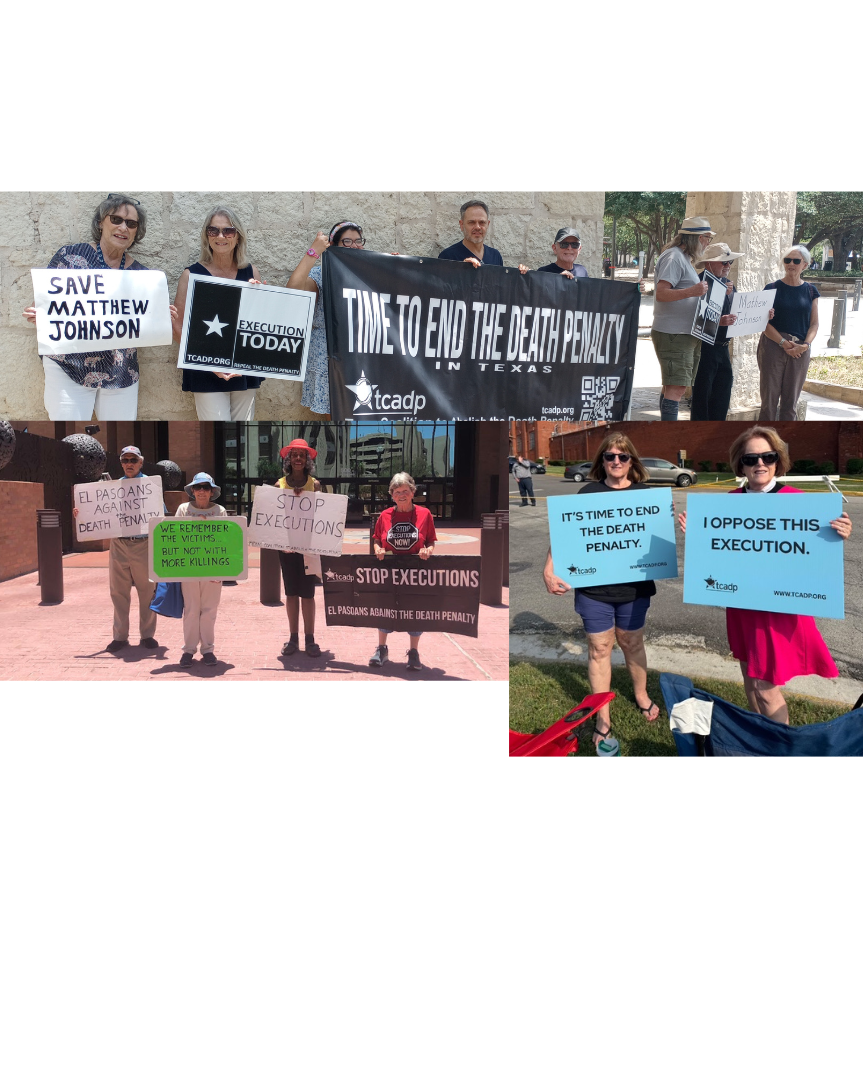
On the days of scheduled executions, we encourage you to take part in vigils in your area. Follow TCADP on social media for case updates (@TCADPdotORG on X/Twitter and @tcadp on Instagram and Facebook).

Texas Executions in 2026

Scheduled Executions (4)

LeJames Norman: September 16, 2026 (Jackson County)

Ramey Ker’sean Olajuwa:
September 16, 2026 (Jackson County) [Norman and Ker’sean Olajuwa are co-defendants.]

Jamaal Howard: October 7, 2026 (Hardin County)

John Rubio: November 12, 2026 (Cameron County)

Executions (4)

On January 28, 2026, Texas carried out the nation’s first execution of the year, putting Charles Thompson to death for killing Dennise Hayslip, his on-and-off girlfriend, and her friend Darren Cain in 1998 in Tomball (a Houston suburb). Thompson, who was 55, spent nearly 27 years on death row.

Thompson used his final moments to apologize to the families of Hayslip and Cain and ask for their forgiveness. “There is no winners in this situation, it creates more victims and traumatizes more people 28 years later,” Thompson said.

***

On March 11, 2026, the State of Texas executed Cedric Ricks. Ricks was sentenced to death for killing his girlfriend, Roxann Sanchez, and her eight-year-old son, Anthony Figueroa, in Tarrant County in 2013. In his last words, he expressed his remorse and apologized to Sanchez’s surviving son.

Ricks’s cert petition and application for a stay of execution were denied by the Supreme Court of the United States earlier in the day. His attorneys had asked the Justices to intervene, arguing prosecutors violated Ricks’ constitutional rights by eliminating potential jurors on the basis of race.

***

James Broadnax was executed by the State of Texas on April 30, 2026. He was sentenced to death at age 20 by a nearly all-white jury in Dallas in 2009. His case raised serious concerns, including the use of his rap lyrics as evidence of his “future dangerousness,” the exclusion of Black jurors, and a recent confession by his co-defendant, Demarius Cummings, that he was responsible for killing Stephen Swan and Matthew Butler during the robbery, not James.

Despite these unaddressed issues, and despite evidence of James’s personal growth, rehabilitation, and commitment to mentoring others during his nearly two decades on death row, the courts and Governor declined to intervene, and clemency was denied.

In a statement provided after the execution, his attorneys and wife shared that “James was a caring, thoughtful, spiritual and deeply intelligent person who positively impacted all who came to know him. He will be missed by all of us and by his family and many friends.  James spoke often of his feelings for the families of Mr. Swan and Mr. Butler, and about his remorse for his role in these crimes, and our thoughts at this time are with their families as well, as James’ were.”

On May 14, 2026, the State of Texas executed Edward Busby after the Supreme Court of the United States vacated a stay that had been granted by the Fifth Circuit Court of Appeals. Experts agreed that he had intellectual disability and should have been exempt from the death penalty. Read TCADP’s statement.

Past Clemency Campaigns

In this section, you will find examples of clemency campaigns TCADP has supported in recent years. We appreciate everyone who participated in these campaigns and raised their voices in opposition to all executions in Texas.

Ramiro Gonzales

Source: Elisabetta Diorio

On June 26, 2024, the State of Texas executed Ramiro Gonzales after the U.S. Supreme refused to consider his final appeals. Earlier in the week, the Texas Board of Pardons and Paroles voted unanimously against recommending clemency or a reprieve, despite evidence of Ramiro’s rehabilitation and remorse.

STATEMENT OF THEA POSEL AND RAOUL SCHONEMANN, COUNSEL FOR RAMIRO GONZALES:

Last night the State of Texas executed Ramiro Gonzales for a crime he committed as an eighteen-year-old boy. The man put to death for those acts was a different person. We are heartened that so many of you saw this.

Without the tools, support, or guidance that many of us take for granted, in the face of abuse and neglect most will never know, Ramiro floundered as a lonely and directionless child and teenager. He made poor choices. He sought escape through drugs. And he caused irrevocable harms. He took the life of Bridget Townsend, and he attacked Florence Teich. We grieve for these women and their families. So did he.

But the Ramiro who the State of Texas killed tonight was not the Ramiro who committed these crimes twenty years ago. The Ramiro who left this world was, by all accounts, a deeply spiritual, generous, patient, and intentional person, full of remorse, someone whose driving force was love. He sought to spread and embody love in all aspects of his life, even in the deprivation and physical isolation of death row where he lived for the past 18 years.

He showed love through his ministry to the men incarcerated alongside him—sometimes that looked like sermons and prayers, sometimes it looked like silly jokes, sometimes it looked like purchasing food for those without money in their accounts. He showed love in his relationships with many friends across the world, from pen pals and spiritual advisors to many semesters of our students, all of whom were touched by his genuine care for them and interest in their lives. He showed love to his family and friends through his art, his words, and his actions. And he showed love through his tireless efforts to donate a kidney to a stranger in need.

Ramiro knew he took something from this world he could never give back. He lived with that shame every day, and it shaped the person he worked so hard to become. If this country’s legal system was intended to encourage rehabilitation, he would be an exemplar.

Ramiro grew. Ramiro changed. May we all strive to do the same.

Ramiro’s spiritual advisor, Rev. Bri-anne Swan, who was with him on the day of his execution and in his final moments, published this heartbreaking piece about his senseless death.

Thanks to everyone who signed the petition in supportof Ramirowatched his clemency video, or shared his story.

Ivan Cantu
On February 28, 2024, the State of Texas put Ivan Cantu to death despite grave doubts about the integrity of his conviction and widespread calls to stop his execution. Cantu maintained his innocence throughout his two decades on death row. The Texas Court of Criminal Appeals and the U.S. Court of Appeals for the Fifth Circuit denied relief and refused to stop his execution. Texas Board of Pardons and Paroles did not recommend clemency or a reprieve for Cantu.

Cantu also faced execution in April 2023 before the date was withdrawn by a district court judge in Collin County, who agreed additional legal proceedings were necessary. In August 2023, the Texas Court of Criminal Appeals denied Cantu’s appeal and Collin County set a new execution date.

Cantu was convicted of killing his cousin James Mosqueda and James’s fiancé, Amy Kitchen, in north Dallas in 2000. An independent investigation into the case exposed multiple falsehoods in the testimony of Amy Boettcher, who was Cantu’s girlfriend at the time of the crime and the main witness against him at trial. Her brother, Jeff, has disavowed his testimony against Cantu at trial, insisting he was not credible because of his history of drug abuse. None of this evidence was reviewed by any court as it came to light after Cantu’s state and federal habeas corpus proceedings had concluded.

Disturbed by the prospect they heard false and misleading testimony during the trial, some of the jurors who sentenced Cantu to death in 2001 wanted this evidence to be reviewed. 

Jury foreman Jeffrey Calhoun wrote in a commentary piece published in the Austin American-Statesman he felt like he “was fooled” by witnesses who lied under oath and he urged the State to stop the execution.

Calhoun wrote, “I am a proud Texan, conservative, and strongly support the direction our governor has taken in upholding the standards and freedom we Texans enjoy. In full respect, I ask Governor Abbott, that you hand me back the document I signed that confirmed the jury’s decision, and delay the execution of Ivan Cantu so further examination can be conducted. This one is unfortunately flawed and therefore incomplete.” 

Read more about the case in these articles, which include interviews with Cantu:

CNN: “With Days Left Before He’s Executed, Ivan Cantu Insists He’s Innocent Of Double-Murder”

NBC News/Noticias Telemundo: “A Texas Man On Death Row Says His Execution This Month Would Be ‘For A Crime I Didn’t Commit’”

TCADP thanks everyone who contacted the Texas Board of Pardons and Paroles and Governor Abbott in support of Cantu’s clemency application.

Brent Ray Brewer

A terrible injustice took place in Texas on November 9, 2023, when the State executed Brent Brewer more than 32 years after he was convicted of killing Robert Laminack in Amarillo. Brewer was 19 at the time of the crime. The robbery and murder of Mr. Laminack in 1990 occurred just weeks after Brewer left a state mental hospital, where he had been involuntarily committed for depression and suicidal thoughts. Like so many on death row, Brewer’s childhood had been marked by neglect and trauma caused by repeated exposure to domestic violence.

Shortly after the U.S. Supreme Court denied Brewer’s final appeals, his attorney issued this heart wrenching statement:

“Brent Brewer will be executed by Texas tonight. His execution is the farthest thing from justice.  Brent’s story is one of complete redemption. He recognized and repented for the deeds he had done and totally redeemed himself during his thirty-four years in prison. The Brent that Texas wished to execute is long gone. The Brent they are killing tonight is a kind, generous, peaceful and thoughtful man who spent the vast majority of his time repenting and in religious studies. He is profoundly remorseful for his crime, committed when he was just nineteen, and he would have done anything to take back the pain he caused the victim’s family.

“It’s also important to note that Brent’s death sentence was a fraud. Texas used the unscientific, baseless testimony of Dr. Richard Coons to claim Brent would be a future danger, although the state and the courts have admitted for years that this exact doctor’s testimony was unreliable and should not be considered by juries in capital cases. Yet the courts repeatedly refused to step in and stop Brent’s execution.  One juror clearly expressed her belief that Brent deserved a life sentence, but Texas’s misleading jury instructions confused her into thinking her vote would not make a difference. Yet the clemency board ignored our pleas for mercy.

“When those of us who know Brent Brewer reflect back on his life, the first word that will come to mind is redemption. He has worked every day on his religious faith which has been at the center of his life. He has cared for everyone who he came into contact with: guards, counselors, fellow inmates, medical staff and his attorneys. He has cared deeply for his family, particularly his sister and they for him. Brent will rest in peace.”


Will Speer

On October 26, 2023, less than five hours before he was set to be put to death, Will Speer was granted a stay of execution by the Texas Court of Criminal Appeals (Texas CCA). 

Speer raised five issues in his application before the Texas CCA, alleging that his counsel had been ineffective for failing to investigate and present his history of unfathomable neglect and abuse to the jury; he also claimed multiple grounds of prosecutorial misconduct, including withholding Brady evidence and presenting false testimony. The CCA stayed the execution pending further order of the Court.

TCADP is grateful to everyone who took part in the campaign to #SaveWillSpeer and to the incredible team of lawyers, mitigation specialists, and investigators who worked tirelessly to save his life. We will provide updates on his case as they become available. Learn more about Will Speer.


Andre Thomas

Andre Thomas resides at the Wayne Scott Unit, the Texas Department of Criminal Justice’s psychiatric facility, where the most mentally ill Texas prisoners are housed. He suffers from schizophrenia and permanently blinded himself by gouging out both of his eyes, on separate occasions. Over the course of his life, Thomas sought treatment for the symptoms of his severe mental illness, but no one responded to his increasingly desperate pleas for help.

Thomas faced execution on April 5, 2023, but the 15th Judicial District Court in Grayson County withdrew that date to allow his legal team reasonable time to investigate and prepare a threshold showing that Thomas is incompetent for execution. The judge has since held that the threshold showing has been made, and a determination of Thomas’s competence will proceed in state courts.

Before the date was withdrawn, dozens of Texas mental health professionals and advocates and over 100 Texas faith leaders, along with national Evangelical leaders and the nation’s leading mental health organizations, filed letters supporting Thomas’s clemency application.

Thanks to everyone who signed and shared the petition to #SaveAndreThomas. We will be in touch with further developments in this case.


Melissa Lucio

Melissa Lucio, one of seven women on death row in Texas, was convicted and sentenced to death in Cameron County in 2008 for causing the death of her two-year-old daughter, Mariah. There is compelling evidence that Mariah’s death was a tragic accident resulting from a head injury she suffered in a fall—not a homicide. 

Update as of November 14, 2024:
Trial Court Recommends Melissa Lucio’s Conviction and Death Sentence Be Overturned; Judge Finds for Lucio on All Claims, Including that She is Actually Innocent
Case is now in the Texas Court of Criminal Appeals for Final Decision

(Brownsville, Texas, November 14, 2024) The judge who presided over the trial of Melissa Lucio—the Honorable Arturo Nelson—has found that Ms. Lucio “is actually innocent; she did not kill her daughter,” Mariah Alvarez. In addition, Judge Nelson agreed with Cameron County District Attorney Luis Saenz that a previous prosecution team suppressed evidence supporting Ms. Lucio’s defense at trial that her daughter died after an accidental fall. The case is now before the Texas Court of Criminal Appeals which will decide whether to accept Judge Nelson’s recommendation that Ms. Lucio’s conviction and death sentence be set aside. 

In April 2024, Judge Nelson found that the former district attorney from Ms. Lucio’s trial illegally withheld favorable evidence that would have helped prove that Mariah died from injuries sustained in an accidental fall, not abuse, as the prosecution claimed. Judge Nelson ruled that the suppression of evidence violated Ms. Lucio’s constitutional rights under Brady v. Maryland and required reversal of her conviction. District Attorney Saenz agreed that Ms. Lucio is entitled to reversal because her constitutional rights were violated.

On June 19, 2024, the CCA returned the case to Judge Nelson to give them recommendations on Ms. Lucio’s remaining three claims which the CCA had also sent to the trial court for consideration when it stayed Ms. Lucio’s execution in April 2022 just two days before her scheduled execution. Judge Nelson has now reaffirmed his prior findings and also ruled that Ms. Lucio’s conviction and death sentence should be overturned based on Ms. Lucio’s three other claims, including her innocence. Judge Nelson’s recommendations are now before the CCA.

“Melissa Lucio lived every parent’s nightmare when she lost her daughter after a tragic accident. It became a nightmare from which she couldn’t wake up when she was sent to death row for a crime that never happened. After 16 years on death row, it’s time for the nightmare to end. Melissa should be home right now with her children and grandchildren,” said Vanessa Potkin, Director of Special Litigation at the Innocence Project, and one of Ms. Lucio’s attorneys. 

“This is the best news we could get going into the holidays,” said John and Michelle Lucio, Ms. Lucio’s son and daughter-in-law. Joined by Ms. Lucio’s son Bobby Alvarez, they added, “We pray our mother will be home soon.”

Judge Nelson signed his new Findings of Fact and Conclusions of Law (FFCL) on October 16, 2024. They were made public today and can be accessed here: https://tinyurl.com/3z9jrwv4   

With respect to Ms. Lucio’s claim of actual innocence, Judge Nelson wrote:

  • There is clear and convincing evidence that Mariah fell on some stairs two days before she died, just as Applicant told police;
  • There is clear and convincing evidence that Applicant was highly susceptible to making a false confession under the interrogation techniques used on her;
  • There is clear and convincing evidence that Mariah’s extensive bruising was not caused by abuse but rather a complication of her fall;
  • There is clear and convincing evidence that Mariah’s fatal head injury was caused by an accidental fall on stairs two days before she died; and
  • There is clear and convincing evidence that the injuries to Mariah that Applicant could have caused based on her confession, even if true, were not clearly dangerous to human life and did not cause Mariah’s death. (FFCL at pp. 58-59)

“The Court therefore concludes that Applicant has met her burden of proof … for actual innocence as no rational juror could have convicted Applicant of killing her daughter after hearing all of the evidence from her original trial alongside all of the new evidence she has presented.” (FFCL at pp. 60-61)

District Attorney Saenz acknowledged, and Judge Nelson found, that at the time of trial the prior District Attorney withheld from the defense evidence that witnesses saw Ms. Lucio’s daughter, Mariah, fall down the stairs and were aware of her deteriorating condition in the days following her fall. Judge Nelson’s order states:

“the suppressed evidence, viewed cumulatively and in light of the record as a whole, provides evidentiary support for the defense that Mariah’s head injury was accidental, and counters the State’s evidence that the injuries could have only been the result of intentional abuse.” (FFCL at p. 23)

 “Considering this suppressed evidence in the context of the other medical evidence in the case” experts “concluded that the likely cause of Mariah’s death was an accidental fall resulting in head trauma.” (FFCL at pp. 25-26)

“[the] suppressed evidence informs a medical diagnosis consistent with Applicant’s defense: that Mariah died as the result of accidental trauma.” (FFCL at p. 13)

Melissa Lucio is represented by:  

  • Vanessa Potkin, Director of Special Litigation, Innocence Project
  • Jane Pucher, Senior Staff Attorney & Legal Clinic Supervisor, Innocence Project
  • Lauren Gottesman, Staff Attorney, Innocence Project
  • Tim Gumkowski, Senior Staff Attorney, Innocence Project 
  • Tivon Schardl, Capital Habeas Unit Chief, Federal Defender for the Western District of Texas
  • Sharon Hernandez, Capital Habeas Unit, Federal Defender for the Western District of Texas
  • Sandra Babcock, Clinical Law Professor, Cornell Law School and Faculty Director/Founder, Cornell Center on the Death Penalty Worldwide
  • Richard Ellis, attorney

More information about Melissa Lucio’s innocence case can be viewed here: https://innocenceproject.org/melissa-lucio-9-facts-innocent-woman-facing-execution/  

###

Update as of April 16, 2024:
Statement of Melissa Lucio’s Attorneys

“On April 12, 2024, the Honorable Judge Arturo Nelson entered findings of fact and conclusions of law recommending that the Texas Court of Criminal Appeals (CCA) overturn Melissa Lucio’s conviction and death sentence. Judge Nelson, who presided over Melissa’s trial, found that critical information was withheld from the defense at the time of trial. On April 25, 2022, the CCA issued a stay of execution for Melissa and ordered the 138th Judicial District Court of Cameron Country to consider new evidence of her innocence in the death of her daughter, Mariah Alvarez, along with other claims challenging the fairness and reliability of her conviction. Following the remand and in response to the CCA’s directive, the Cameron County District Attorney’s Office undertook further review of Melissa’s case. After that review, the DA’s office concluded that the undisputed facts show that favorable evidence was withheld from Melissa’s defense team at the time of trial. Judge Nelson found that critical information was withheld from the defense at the time of trial and that Lucio ‘met her burden of proof, by a preponderance of the evidence, that she would not have been convicted in light of the suppressed evidence.’ The case now moves to the CCA, which has the ultimate power to decide whether the conviction should be set aside.”

— Vanessa Potkin, Director of Special Litigation at the Innocence Project; Richard Ellis, attorney at law; Tivon Schardl, Chief of the Capital Habeas Unit for the Federal Public Defender in the Western District of Texas; and Professor Sandra Babcock, Director of the Cornell Center on the Death Penalty Worldwide, Melissa Lucio’s Attorneys

— April 15, 2024

Statement of the Family of Melissa Lucio

“We are grateful to our mother’s legal team for their hard work to bring the truth to light and to D.A. Saenz for taking another look at our mother’s case and recognizing that she did not receive a fair trial and her conviction should be overturned. Important evidence that our sister Mariah’s death was an accident, not a murder, was never presented to the jury. We hope and pray the Court of Criminal Appeals will agree with the District Attorney, the defense, and Judge Nelson and our mother can come home to her family. It’s been 17 years that we have been without her. We love her and miss her and can’t wait to hug her.”

— Bobby Alvarez, Melissa Lucio’s son
— John and Michelle Lucio, Melissa’s Son and Daughter-in-Law

— April 15, 2024

The court’s order can be viewed here: https://tinyurl.com/yzmcf5r4 

The joint statement of the Cameron County District Attorney and the Legal Team for Melissa Lucio can be viewed here: https://tinyurl.com/5f6vpsck

Agreed Findings of Fact and Conclusions of Law on Applicant’s First Subsequent Application for a Writ of Habeas Corpus can be viewed here:https://tinyurl.com/jhjh7a5v

For more information, visit https://innocenceproject.org/who-is-melissa-lucio-death-penalty-texas-execution-innocent/

Background information
On April 25, 2022, just two days before her scheduled execution, the Texas Court of Criminal Appeals granted a stay to Melissa Lucio. The Court ordered the 138th Judicial District Court of Cameron County to consider multiple claims related to new evidence of Melissa’s innocence of the accidental death of her daughter, Mariah.

You can find statements from Melissa Lucio and her attorneys in response to the stay here.

The Court’s Stay Order re: Application for Post-Conviction and Habeas Petition: https://tinyurl.com/42h4zb6n

Melissa Lucio’s First Subsequent Application for Writ of Habeas Corpus can be viewed here: https://tinyurl.com/2paxuabx

We are grateful to everyone who contacted the Texas Board of Pardons and Paroles and Governor Abbott, signed the Innocence Project petition, shared information about Melissa’s case with your networks, or otherwise took action to #SaveMelissaLucio. We also want to express our appreciation to her legal team and everyone who supported them in the effort to stop this execution. We will continue to monitor her case for new developments and share updates with you. 

What is Clemency?

In capital cases, clemency entails the commutation of a death sentence to life in prison or a reprieve of execution. In order for the Texas Board of Pardons and Paroles to consider clemency for a person facing imminent execution, an application for clemency must be filed.

The Governor of Texas has the independent authority to issue a one-time 30-day reprieve but can grant clemency only upon the recommendation of the Board of Pardons and Paroles. However, a recommendation from the Board of Pardons and Paroles is not binding.

Who is on the Texas Board of Pardons and Paroles?

Current Members:
Marsha Moberley (Chair)
Elodia Brito
Sandra Fletcher
Clint Gunnels
Brian Long
Linda Molina
Ed Robertson

Write the Governor of Texas and the Texas Board of Pardons and Paroles

You are welcome to contact the Board and Governor even when there is no specific clemency campaign. Please note that clemency applications typically are filed 21 days before the execution date, so it is best to send a letter of support around that time. Include the TDCJ #, date of birth, and full name of the person on whose behalf you are writing.

The Board typically informs attorneys of its decision two business days before the execution date.

Here are some general talking points for your letters:

  • State your concerns about the inherent flaws and failures of the Texas death penalty system.
  • Express outrage that executions continue to take place in Texas.
  • Urge the Board of Pardons and Paroles to recommend clemency.

Contact information for calls, letters, and emails:

Texas Board of Pardons and Paroles
Clemency Section
8610 Shoal Creek Boulevard
Austin, Texas 78757
Fax (512) 467-0945
Online Contact: bpp_clemency@tdcj.texas.gov

*The Board prefers to receive written communication by letter or email.

Texas Governor Greg Abbott
Office of the Governor
P.O. Box 12428
Austin, Texas 78711-2428

Information and Referral Hotline: (800) 843-5789 [for Texas callers]
Information and Referral and Opinion Hotline: (512) 463-1782 [for Austin, Texas and out-of-state callers]
Office of the Governor Main Switchboard: 512-463-2000

Online Contact: https://gov.texas.gov/contact/

The governor can grant clemency only upon the written recommendation of a majority of the Board of Pardons and Paroles, whose members he appoints.  He has the limited authority to grant a one-time, 30-day stay of execution.

Clemency in Texas

Since 1982, the Texas Board of Pardons and Paroles has recommended the commutation of a death sentence in only five cases where the inmate faced imminent execution. Then-Governor Rick Perry rejected two of those recommendations and allowed the executions to proceed

  • Henry Lee Lucas – Governor George W. Bush commuted his sentence in 1998 due to lingering concerns about his guilt. Lucas died of natural causes in prison in 2001 while serving a life sentence.
  • Kelsey Patterson –  The Board voted 5-1 for clemency but Governor Rick Perry rejected the recommendation. Patterson had a long-standing diagnosis of paranoid schizophrenia. He was executed on May 18, 2004.
  • Kenneth Foster – Governor Perry commuted Foster’s sentence in 2007 due to concern about a Texas law that allowed capital murder defendants to be tried simultaneously. The Board recommended clemency by a vote of 6-1. Foster had been convicted under the law of parties for a 1996 murder, even though he was sitting in a car 80 feet away at the time of the crime. He is serving a life sentence.
  • Robert Lee Thompson – Governor Perry rejected the Board’s 5-2 recommendation for clemency even though Thompson was not the triggerman in the murder of Mansoor Rahim. He had been convicted under the law of parties. His co-defendant, Sammy Butler, the actual killer of Mr. Rahim, was tried separately and convicted on a lesser charge. Butler is serving a life sentence and will be eligible for parole. Thompson was executed on November 19, 2009.
  • Thomas “Bart” Whitaker – On February 22, 2018, Governor Greg Abbott accepted the Board’s unanimous recommendation of clemency for Whitaker, who was scheduled to be executed that same day.  It was the first such commutation in Texas since 2007.  Whitaker is now serving life in prison without the possibility of parole. Read the Governor’s statement here.